Independent lab · updated Q2 2026

Bitcoin Mixers 2026 — read the wiring, not the marketing

We take the best BTC mixers and Bitcoin tumblers of 2026 apart on a bench: pool size, routing model, log policy, guarantee format, and what actually happens to your coins between the deposit and the output. No affiliate rankings, no fake "editor's choice".

  • 17mixers benched this year
  • 3architectures dissected
  • 0paid placements
01

What a Bitcoin mixer actually does in 2026

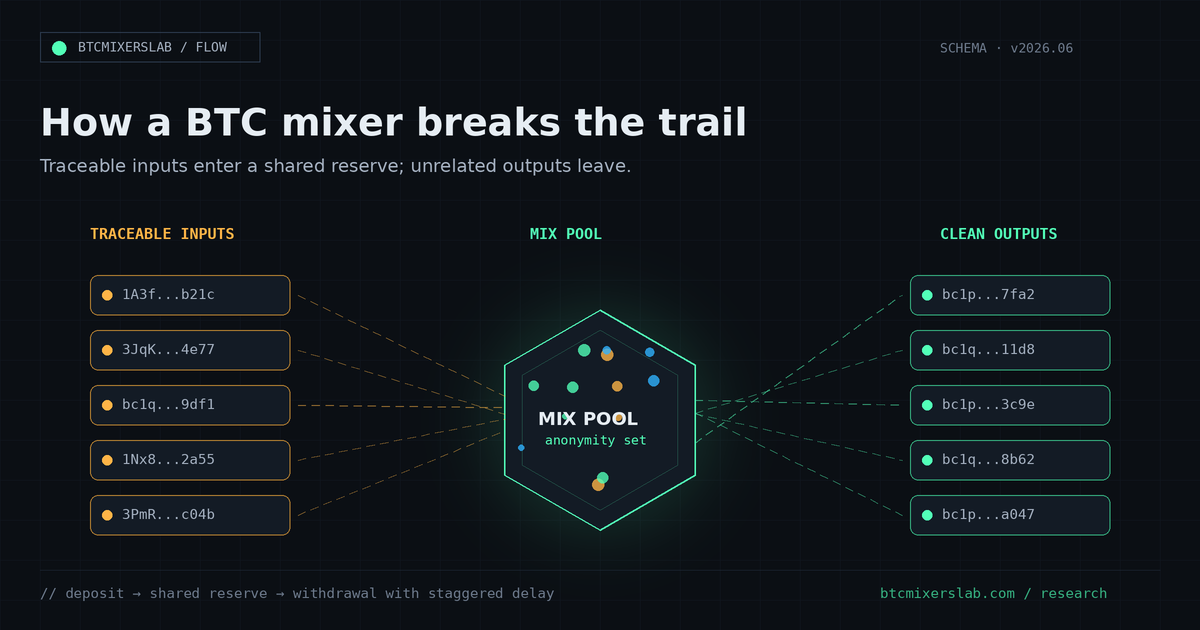
A Bitcoin mixer, also called a tumbler, is a service that breaks the deterministic link between the address that sent coins and the address that receives them. On a public ledger every payment is traceable by default. A mixer inserts a controlled amount of uncertainty into that trail so an observer with only chain data cannot connect the two ends.

In 2026 the space has consolidated. Half of the mixers that were online three years ago are gone — some seized, some retired, most simply out of demand. What remains is smaller, more technical, and considerably better engineered. Fee compression pushed weak operators out, and the survivors run larger reserves, cleaner code and stricter no-log policies.

02

Three mixing architectures, side by side

Almost every service in 2026 belongs to one of these three families. The differences matter more than any marketing copy.

Centralized pool

The classic model. You deposit into a shared reserve, the operator sends back different coins from the same reserve after a delay. Trust sits entirely with the operator's no-log policy and their letter of guarantee.

  • Fastest option, works with any wallet.
  • Custodial — the operator holds funds briefly.
CoinJoin coordinator

Multiple users co-sign a single transaction with equal-value outputs. No operator ever takes custody. The coordinator only helps participants find each other; the signatures come from your own wallet.

  • Non-custodial by design.
  • Needs a compatible wallet, slower rounds.

Zero-knowledge routing

The newest branch. Deposits and withdrawals are linked through a cryptographic proof rather than a shared pool. The operator can verify a payment exists without ever knowing which one belongs to which user.

  • Strongest privacy guarantee on paper.
  • Fewer live implementations, higher fees.
03

The best BTC mixers of 2026 — profiled one by one

Short lab notes on the top crypto mixers still worth benchmarking this year. Independent research, no paid placements, no affiliate rankings.

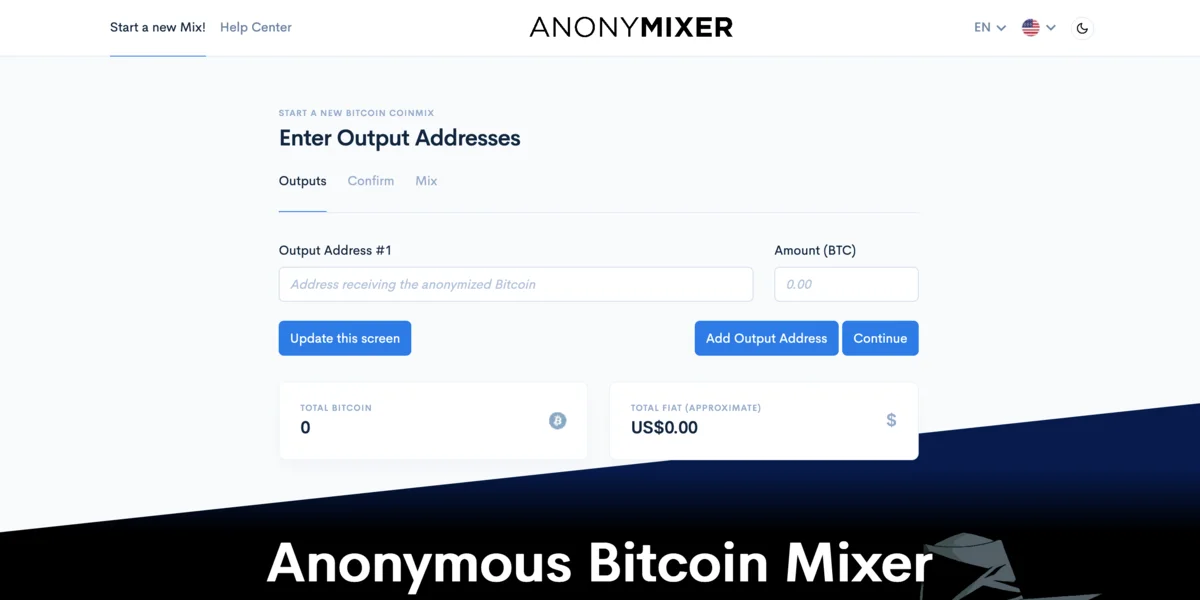
Anonymixer

Centralized pool

A modern BTC mixer with a clean web interface and a randomized fee model that varies each session. Supports several output addresses per mix and issues a PGP-signed letter of guarantee before any deposit is accepted.

  • Min: 0.001 BTC
  • Fee: randomized
  • Delay: 0–72h
  • Guarantee: PGP

Coinomize

Centralized pool

Running since 2019, Coinomize is one of the more established centralized Bitcoin tumblers. Fee is user-controlled on a slider, up to eight output addresses are supported, and each session ships with a signed letter of guarantee.

  • Min: 0.001 BTC
  • Fee: 0.5 – 5% (custom)
  • Outputs: up to 8
  • Guarantee: PGP

CryptoMixer

Centralized pool

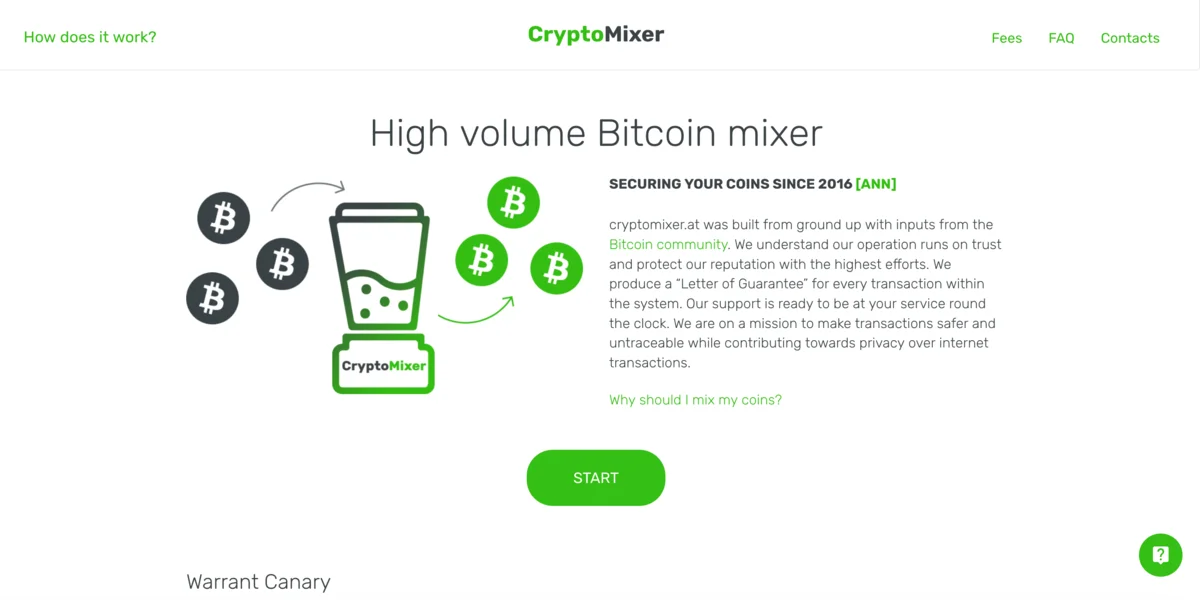
One of the longest-lived Bitcoin mixers still online — active since 2016. Known for a large public reserve and a code system that prevents the same user's coins from being returned in a future round. Fee is percentage-based plus a small per-output fee.

  • Min: 0.001 BTC
  • Fee: from 0.5% + per-output
  • Delay: 1 – 24h
  • Guarantee: PGP + code

Mixero

Centralized pool

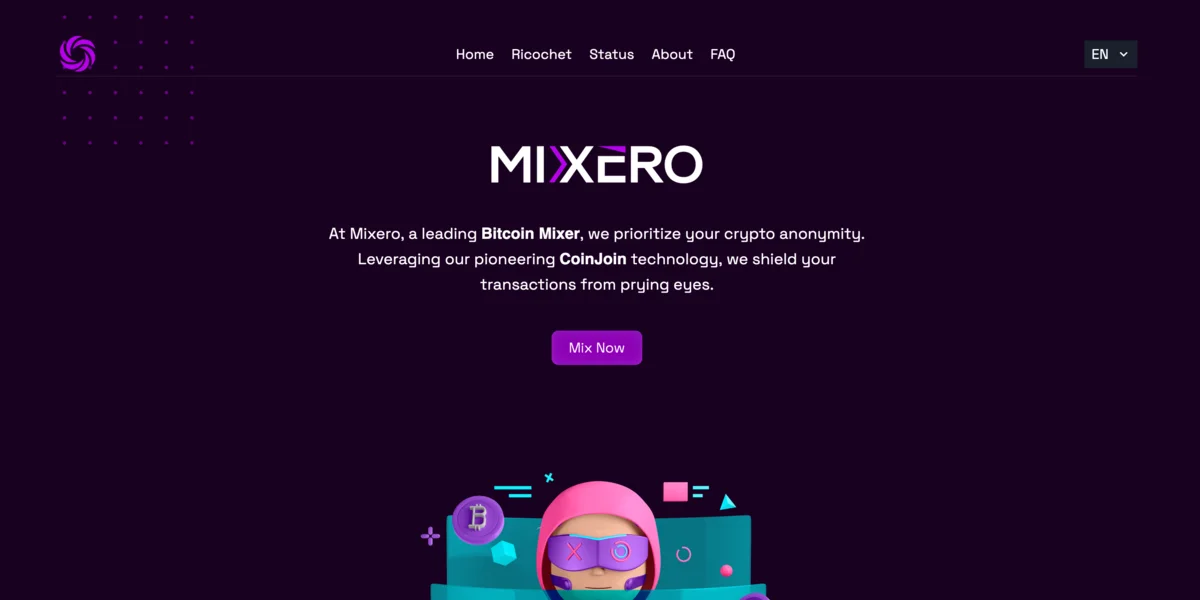
A modern crypto mixer supporting both Bitcoin and Ethereum. Randomized fee inside a fixed band, multiple outputs, and a delay slider. Clean UI, PGP letter of guarantee, both .onion and clearnet mirrors.

  • Min: 0.001 BTC
  • Fee: 1 – 5% (random)
  • Outputs: up to 8
  • Guarantee: PGP

Mixtum

Centralized pool

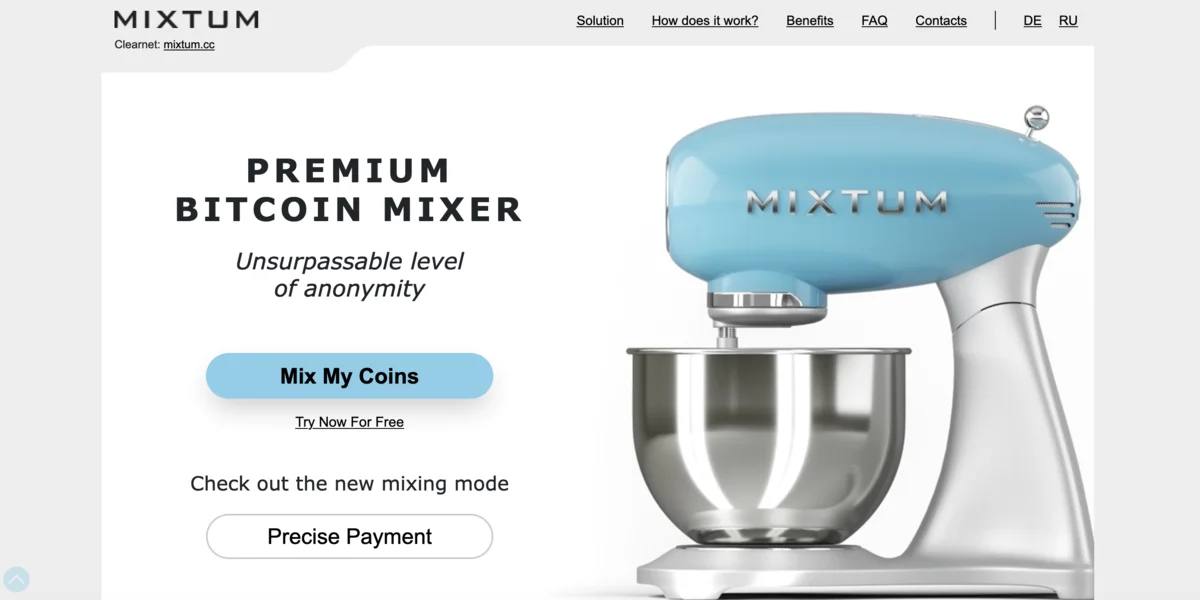
A no-frills centralized BTC mixer built around a simple two-step flow. Flat percentage fee, straightforward interface, Tor-first infrastructure and a PGP letter of guarantee for every session.

  • Min: 0.0025 BTC
  • Fee: 4% flat
  • Delay: 0 – 24h
  • Guarantee: PGP

Tornado

Centralized pool

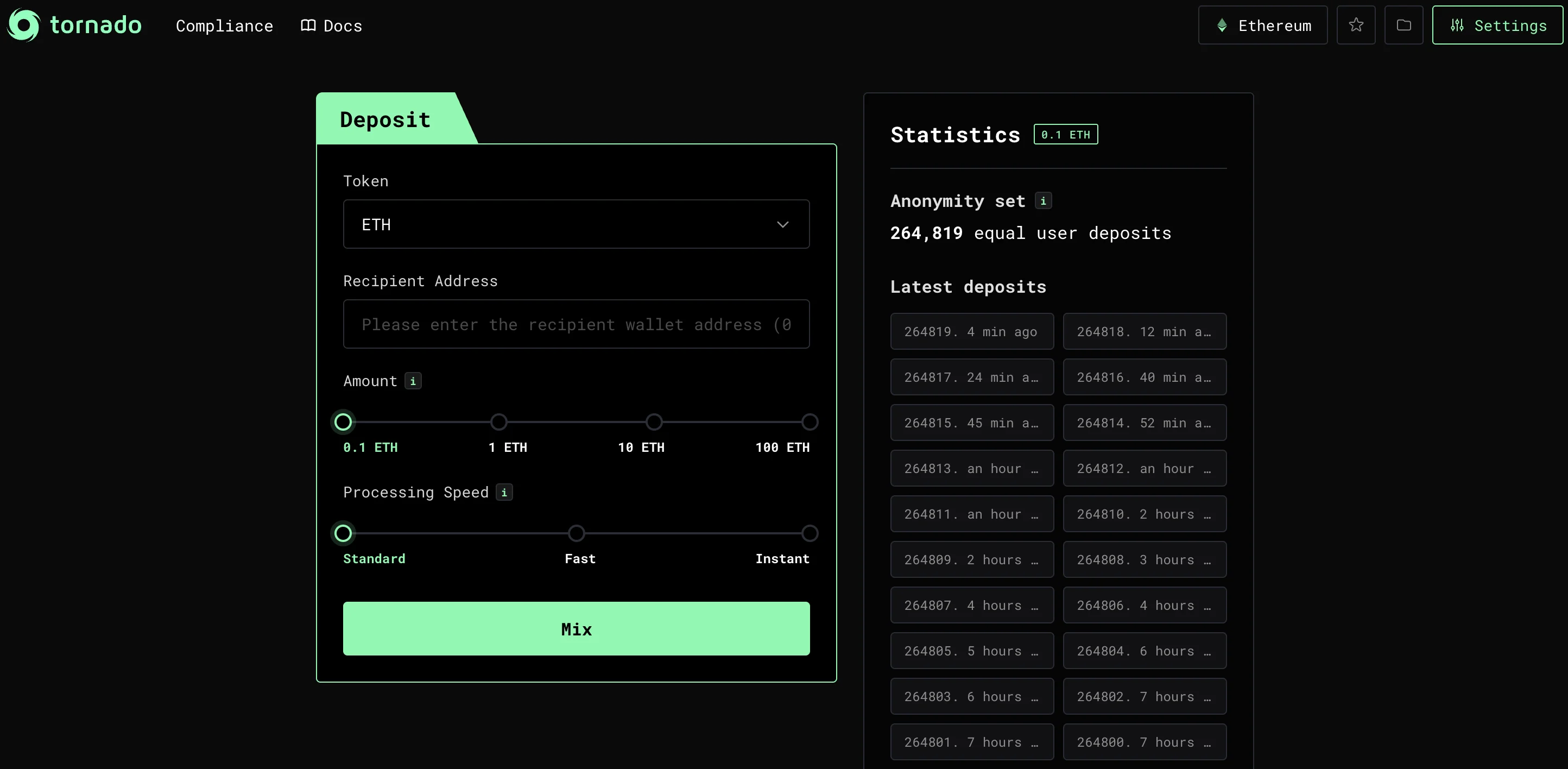
A centralized-pool Bitcoin mixer positioned as a fast-throughput option, with randomized fees and adjustable delay. Not affiliated with the sanctioned Ethereum project of a similar name — this is a BTC-only service on separate infrastructure.

  • Min: 0.002 BTC
  • Fee: 0.5 – 3%
  • Delay: 0 – 48h
  • Guarantee: PGP

UniJoin

CoinJoin

A CoinJoin-based service that groups participants into coordinated equal-output transactions. Non-custodial by design — signatures come from your own wallet, so the operator never takes possession of the funds.

  • Min: 0.005 BTC
  • Fee: ≈ 0.3%
  • Model: round-based
  • Custody: none

WebMixer

Centralized pool

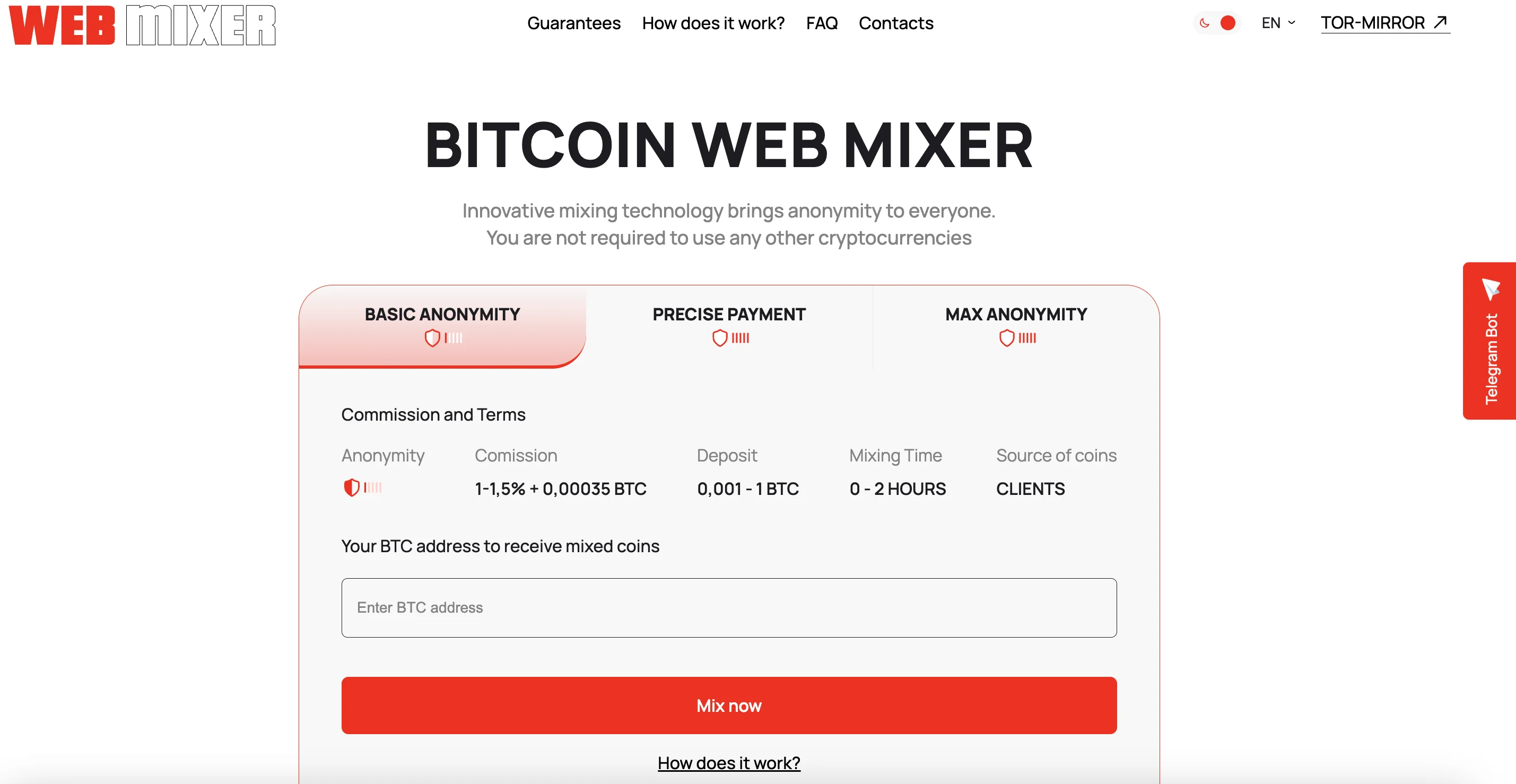
A Bitcoin mixer available on both clearnet and Tor. Centralized reserve model with a stated no-log policy, adjustable delay and a signed letter of guarantee generated at the start of each session.

  • Min: 0.001 BTC
  • Fee: 0.5 – 5%
  • Delay: 0 – 48h
  • Guarantee: PGP

Whir

CoinJoin

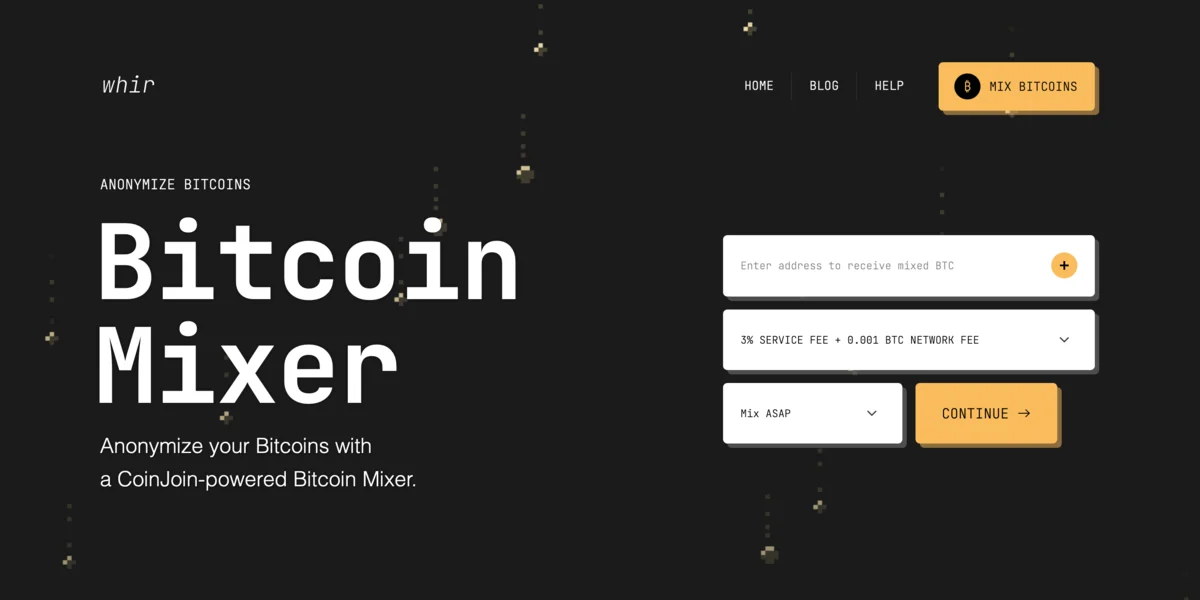
A CoinJoin-focused Bitcoin service built around a mobile-first workflow and a lightweight coordinator. Non-custodial by design; frequently referenced as a case study for how compact CoinJoin implementations work on Bitcoin.

  • Min: 0.005 BTC
  • Fee: ≈ 0.4%
  • Model: round-based
  • Custody: none

Yomix

Centralized pool

A centralized Bitcoin tumbler with a user-adjustable fee, custom time delay and support for several outputs per mix. Provides a PGP-signed letter of guarantee at the deposit stage and runs a stable .onion presence.

  • Min: 0.001 BTC
  • Fee: 1 – 4%
  • Delay: 0 – 96h
  • Guarantee: PGP

Data reflects publicly disclosed parameters at the time of research. Fees, delays and reserves change — always verify on the operator's signed announcement before sending funds.

Diagram of how a BTC mixer breaks the on-chain link — traceable inputs entering a shared mix pool and clean unlinked outputs leaving
04

Who uses Bitcoin mixers, and why

Long-term holders

People who bought early and want to move coins to cold storage without publishing their net worth on a public ledger. A single KYC purchase from 2017 links a lifetime of transactions unless the trail is broken.

Merchants and freelancers

Anyone accepting Bitcoin for goods or services ends up with a receiving address that can be scraped by competitors, customers, or scammers. Mixing separates the operational wallet from the treasury.

Journalists and activists

Donations from readers should not become a threat model. In hostile jurisdictions on-chain metadata is a real risk. Mixing removes the direct link between a source and a recipient.

Privacy-first users

Not every reason has to be dramatic. Many people just don't want a shop, an ex, a landlord or a data broker enumerating their wallet. Financial privacy is a normal default in cash; on Bitcoin it takes work.

05

How to mix your Bitcoin — six-step protocol

A clean workflow that survives the common mistakes. Read it once before you touch a mixer.

  1. 1

    Pick a mixer with a public reserve

    A visible cold-wallet address with historical volume matters more than a slick landing page. Small reserves mean small anonymity sets.

  2. 2

    Verify the onion address or mirror

    Phishing clones outnumber real mixers. Check the address against at least two independent sources and the service's signed PGP announcement.

  3. 3

    Prepare fresh output addresses

    Never send output to an address that has ever touched a KYC exchange or your public identity. Generate new addresses in a wallet you control.

  4. 4

    Choose delay and split

    Splitting the output across two or three addresses with staggered delays multiplies the anonymity set. Instant, single-address withdrawals are the weakest configuration.

  5. 5

    Save the letter of guarantee, then deposit

    Download and store the PGP-signed letter before you send a single satoshi. It is your only leverage if something breaks.

  6. 6

    Wait, receive, do nothing loud

    When the clean coins arrive, do not immediately consolidate them into one address or send them to an exchange. That undoes the work you just paid for.

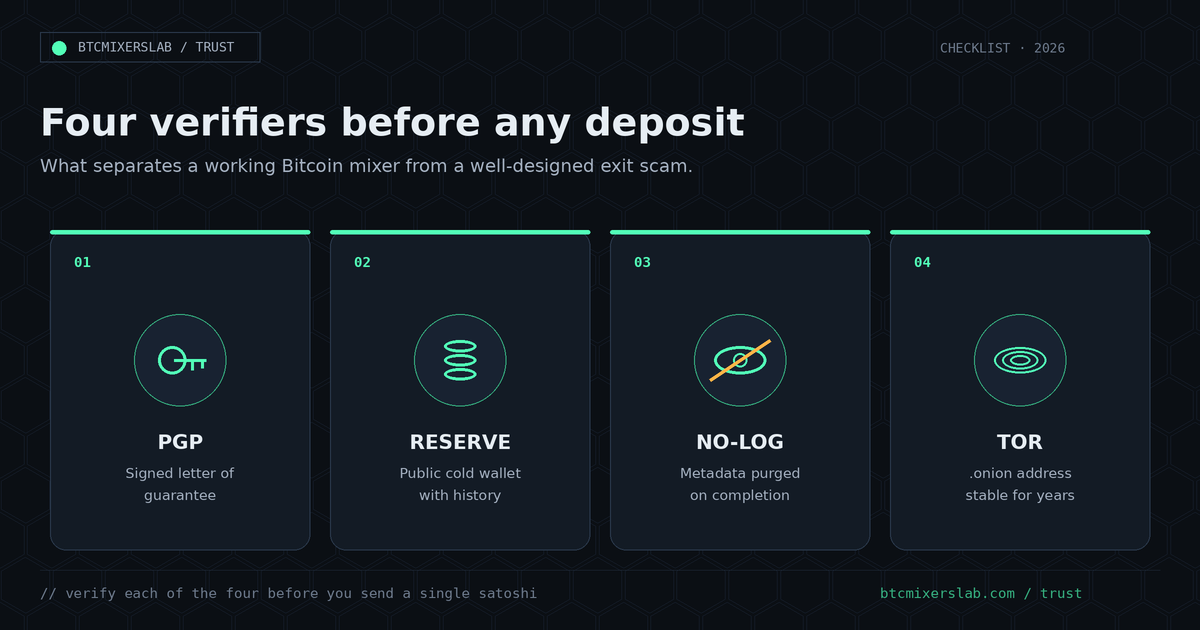
Four trust signals to verify before using a Bitcoin mixer — PGP letter of guarantee, public reserve wallet, no-log policy, stable Tor onion address
06

Security signals that separate a real mixer from a scam

PGP-signed letter of guarantee

Issued before deposit. Contains the address, the fee, the timing. Signed with a key that has been used for at least a year.

Published reserve address

A cold wallet you can inspect on a block explorer. Recent inbound volume tells you the service is actually working.

Stated no-log policy

Not just a checkbox. Look for how long transaction metadata is kept, whether IP addresses touch the pool, and how logs are wiped.

Tor-first infrastructure

An .onion address that has been stable for years. Clearnet mirrors are a convenience, not the source of truth.

Expert column

"Every year the same question comes back: are Bitcoin mixers still relevant? In 2026 the answer is a firmer yes than it was in 2022. Chain analytics companies have industrialised. Every major exchange now runs heuristics that cluster addresses across years of history. A single reused address can retroactively de-anonymise a decade of payments."

"The mixers that survived the last cycle are the ones that treated privacy as an engineering problem rather than a marketing angle. Larger reserves, cleaner log hygiene, and — this is the important shift — an honest acknowledgement that the mixer alone is not enough. Users who combine a competent tumbler with proper address discipline get real privacy. Users who mix and then send straight to a KYC exchange get a paper trail with extra steps."

— Independent privacy researcher, chain-analysis background
07

Frequently asked questions

Is using a Bitcoin blender legal in 2026?

In most jurisdictions holding Bitcoin and improving your on-chain privacy remains legal. Regulation applies to how you disclose funds, not to the act of mixing itself. Check the rules of your own country before using any service.

How long does a Bitcoin mixing transaction usually take?

Most modern mixers complete the operation within one to six hours. Time depends on the delay you set, the number of confirmations required, and current mempool load.

Can a Bitcoin tumbler be traced back to me?

A properly designed no-log mixer with a large reserve pool cannot be linked to a single user by looking at the blockchain alone. Traceability risk comes from reused addresses, KYC exchanges, and browser fingerprints, not from the mixer itself.

What is a letter of guarantee and why does it matter?

It is a PGP-signed document a mixer issues before you send funds. It records the deposit address, the promised output, and the operator's obligation. If anything goes wrong, that letter is your proof.

Do BTC mixers still work after the Tornado Cash sanctions?

Yes. Tornado Cash was an Ethereum service. Bitcoin mixers operate on a different chain and a different legal footprint. The 2026 landscape has fewer players but the survivors are technically stronger.

What is the difference between a mixer and a CoinJoin?

A classic mixer takes custody of your coins and returns different coins from its pool. A CoinJoin is a collaborative transaction where several users sign one transaction together, so no operator ever holds funds.

What is the safest way to receive mixed coins?

Fresh addresses in a wallet you fully control, split across two or three outputs with staggered timing. Avoid sending mixed coins to any address that has ever been linked to your identity.